I Told a Founder to Get Listed on the Review Sites. AI Was Citing Her Competitors’ Homepages.
I build Orbator. It measures whether AI assistants recommend your product, and traces which sources they read before answering.
A founder emailed last week asking which two or three placements would move the needle for her consumer money app. I assumed the answer was directories and review sites, because that is the advice everyone gives. My own data should have warned me. Across the software categories I track, the most cited domains are reddit and youtube. G2 is the biggest review site, close to four times Capterra, but it sits eighth overall and reddit gets cited almost nine times as often.
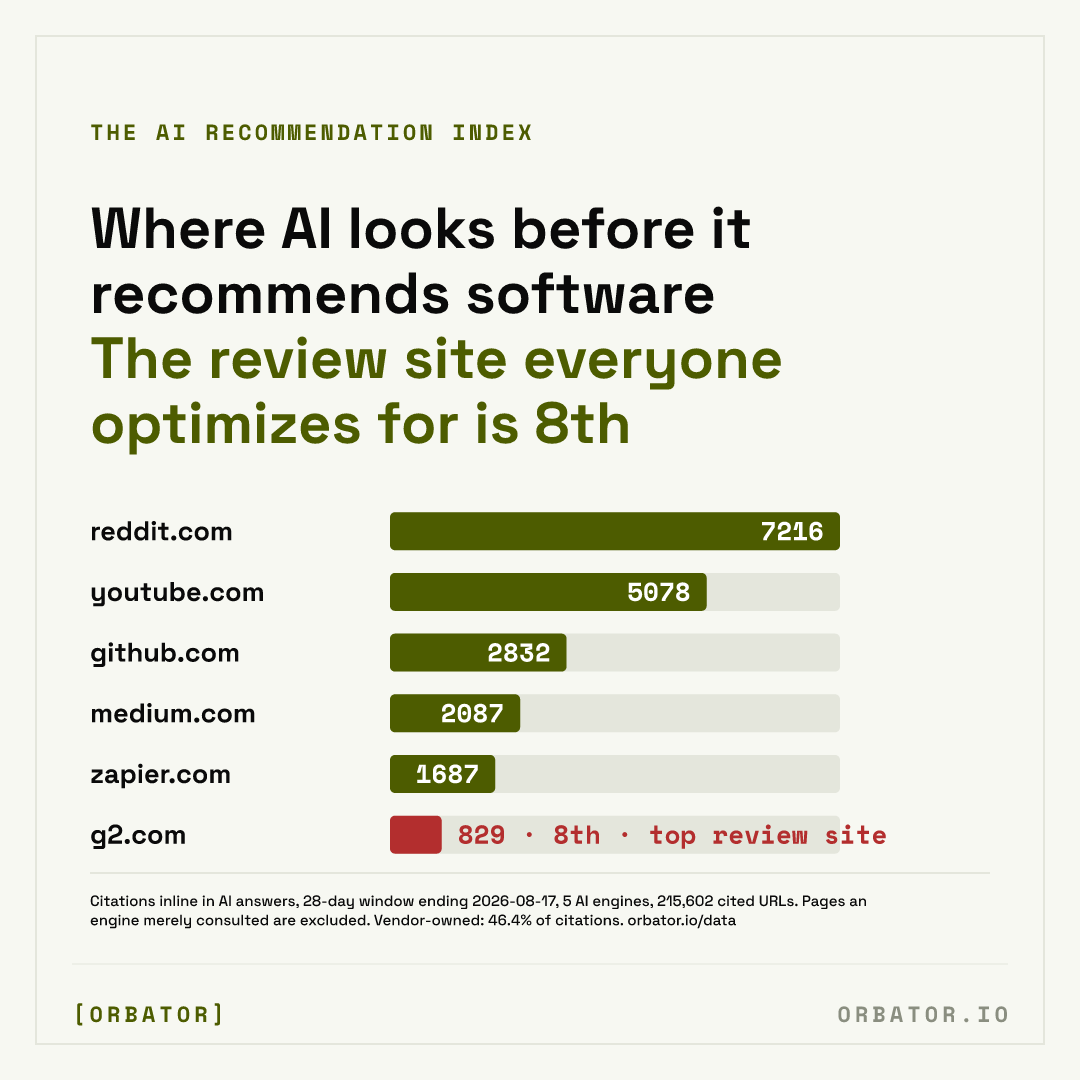
Reading her actual report changed my answer
For the question that matches her differentiator, an app that works without connecting your bank, the engines had cited three pages. After checking all three, every one was a competitor’s own website. Not a review site, not a listicle. Just products like hers, being used as the source. One of them runs almost exactly her pitch, a 0 to 100 money score with no bank linking, and it gets cited while she gets nothing.
So the assumption was wrong. The gatekeeper was not an editor at a review site. It was her own homepage. Those competitor pages get cited because they say it plainly, right there on the page: “never link a bank”, “no bank linking required”. Her site says it once, as a feature bullet.
The directory playbook is a B2B playbook
Here is what I had missed. The directory playbook is real, it is just a B2B playbook. When someone is buying a tool for work there is a G2 page to lean on. For consumer apps there is no G2, so the engines fall back on whoever explains the category best, and that is usually a competitor. I had one dataset, I had not even read it closely, and I assumed it applied everywhere.
The other half of the picture is who owns the pages the engines read at all. Across the same window, 46.4 percent of the citations we log come from a vendor competing in the category being asked about. Nearly half the “independent” research an answer rests on was written by someone with a horse in the race.
The test I use now
Look at who is already getting named. All household names, skip that question, you are not displacing them this quarter. Apps you have never heard of in there, the slot is open, and the page that wins it is usually the one that states the thing plainly instead of burying it in a feature list.
The uncomfortable version of this finding: if the sources an engine reads are mostly competitor pages, then the highest-leverage page you can fix is your own. Not a placement you rent. A page you own.
Which sources are the AI answers in your category actually built on? You can check by hand — ask the buyer question in each engine and read what it cites — or look at what we measure across five engines in the open AI Recommendation Index.
Put This Into Action with Orbator
Submit your SaaS to curated directories, track proof, and manage launch visibility from one dashboard.
Frequently Asked Questions
Get answers to common questions about Orbator