Google penalised one of my sites last month.
Impressions are down 91.5% week over week. Four clicks. Average position 64, which is page six, which is nowhere. I built that site as part of a content factory: programmatic pages across a software category, generated at scale, technically clean. It worked for a while and then an anti-spam update landed and it stopped working in about a week.
I am not writing that to be self-flagellating. I am writing it because I want to make an argument about bias in this industry, and I would rather make it from inside the hole than from above it.
Nobody can check anything
This week a well-known SEO put up a post warning people that if they buy backlinks from a particular AI content tool they will get slapped out of the Google index and burn their domain forever. It did 80,000 views in a day. Eighty-three replies. Hundreds of likes.
I think he is probably right. The mechanism he is describing is real, the tool in question does run an opt-in link exchange across its own customer base, and reciprocal patterns across unrelated sites are precisely what link-scheme detection is built to find. The October 2025 spam update named AI-generated content farms with embedded paid links as their own category of abuse. His instinct matches the direction of enforcement.
But read that thread and count the numbers in it. There are none. Not one person on either side, including him, including the people arguing back, produced a sample of sites, a date range, or a measured drop. The strongest claim available to anyone is “I have seen this happen.”
That is the actual state of this industry. Position is sold by assertion, and position is criticised by assertion, and the loudest voice wins because there is no instrument in the room. I am not sneering at that post. I am pointing out that the person with 80,000 views and the person selling the links are both, epistemically, in the same position: telling you what they believe.
I can at least offer a data point rather than a belief, because I am one. My site was scaled content, the update landed in August, and it took about a week to go from working to page six. That is one site, n equals one, and I am telling you the n. Which is more than the thread managed.
What the industry actually sells
The AI visibility market is selling position. It has different names depending on who is selling. Placement. Authority building. Getting listed. Citation seeding. Underneath, it is the same product: pay us and you will appear in more answers.
Some of it is straightforwardly against the rules. Google’s policy is that a link acquired through payment or commercial arrangement carries rel="sponsored" or nofollow, and failing to mark it is itself the violation. The October 2025 spam update went further and named AI-generated guest post farms, sites that exist only to publish thin machine-written articles with paid links inside them, as their own category of abuse.
Some of it is subtler and sits inside tools people use every day. There are AI content platforms whose product includes an opt-in link exchange across their own customer base: the tool writes your article, then inserts a link to another customer’s article, and does the same for them. Nobody signed a contract to buy a link. The network still produces exactly the reciprocal pattern that link-scheme guidance is written to catch, which is why reviewers of those tools keep flagging the feature specifically rather than the tool as a whole.
And a lot of it is not against any rule at all, which is the part people underrate. Writing a “best tools in your category” page that ranks your own product first is completely legal, and it is the single most effective thing you can do right now.
Why it works, in numbers
Across the index I keep, 297 software categories and 132,443 resolved citations, 51.2% of the sources AI engines cite are owned by vendors in the very categories they are cited in. Not analysts. Not press. Not buyers comparing notes. The companies being recommended.
Then I audited one category by hand rather than by script. AI tools for lawyers, 125 sampled answers across five engines, 1,188 citations, every top-cited domain ownership-checked manually. Every one of the 22 most-cited pages was vendor-owned. Twenty belonged to companies recommended in the same answers that cited them. The first genuinely independent source in the whole record ranks 23rd, and it is a Reddit thread with nine citations.
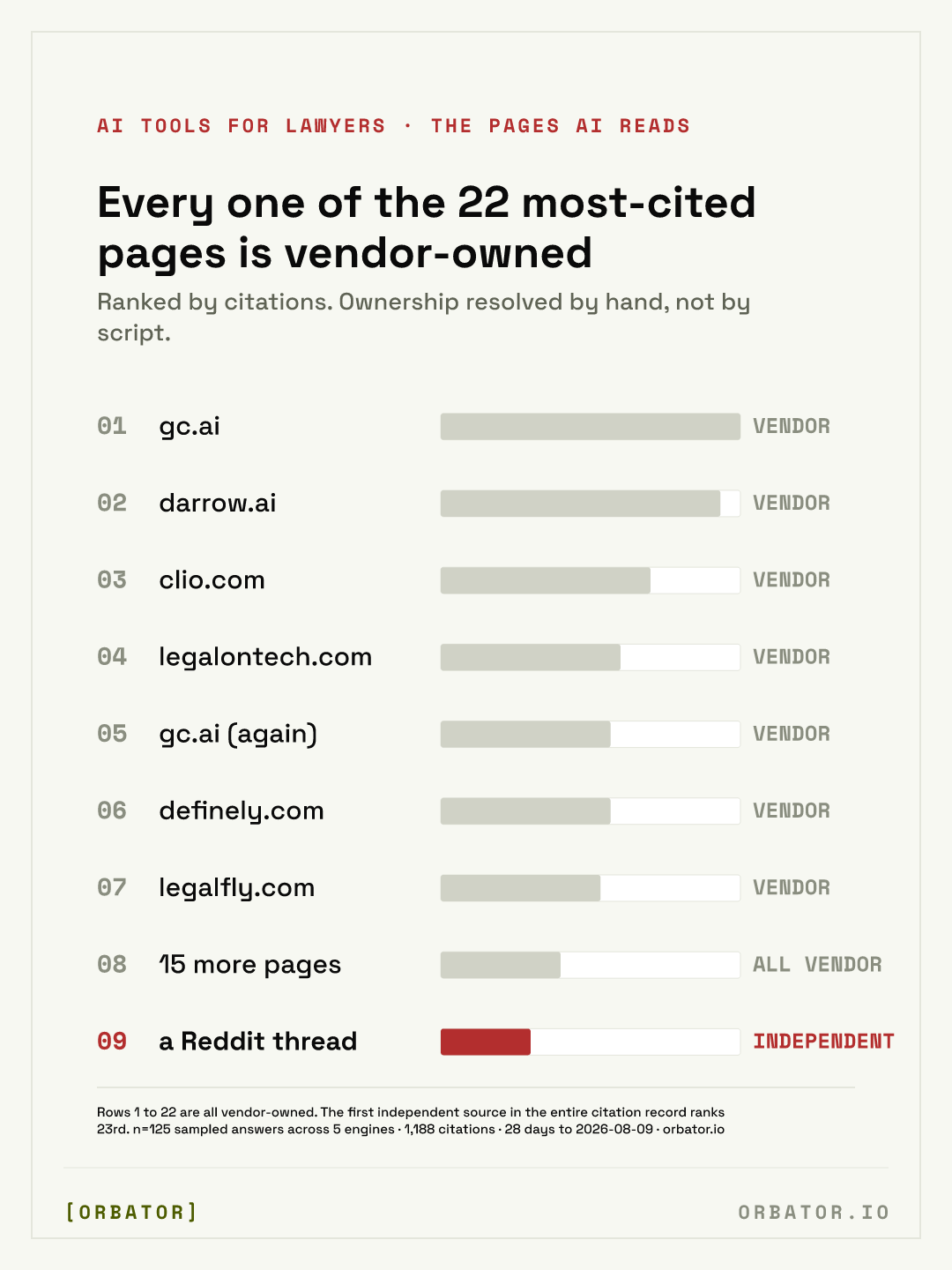
That is why manufactured position sells. If half the material an engine reads is written by the people it is ranking, becoming one of those sources is the shortest path into the answer.
It is also why it is fragile. In late November 2025 Google patched AI Overviews and Gemini against self-published self-ranking listicles and positions built on that surface disappeared overnight. My own site got the same treatment in August. Rented position gets evicted, and neither you nor the person who sold it to you can see the eviction date.
So what would an unbiased index look like
This is the part I actually care about, and it is why I built the thing.
There is no paid tier. Not a discounted one, not a premium one, not a “featured” one. There is no product you can buy from me that changes where you appear in the index, because the index is not a list I maintain. It is a record of what five assistants said when asked a buyer’s question, and I have no mechanism to alter that even if someone waved money at me. If a competitor of mine offers placement, that is the difference worth interrogating.
Every number carries its denominator. A share figure with no sample size behind it is decoration. Mine sit on a median of 42 sampled answers per category and I will not publish a share off fewer than 20 runs of the same question. Every entry publishes a 95% confidence interval, and where two products’ intervals overlap the page says they are not distinguishable.
The cadence is published, including when it is unflattering. The methodology page says sampling is roughly monthly per engine per category at current budget. It would read better to say weekly. It is not weekly, so it does not say weekly.
Methodology changes go in a public changelog, dated. When I redefined what counts as a recommendation, that got a version number and an entry. Nine of them so far. A measurement that quietly changes its definition is not a measurement, it is a marketing surface.
The failures get published too. Two of the top-cited pages in that legal audit were scored as independent by my own automated registry. They were not. Both were “best legal AI” guides published by unranked competitors, each featuring its own product. My registry only flags vendors it already ranks, so a competitor who has not cracked the leaderboard sails straight through as neutral. Only hand-checking caught them. Which means every vendor-owned percentage I publish is a floor, not an estimate, and the true figure is higher than 51.2% by an amount I cannot tell you.
And it measures me, badly. My own product is close to invisible in its own category on my own index. I publish that number next to everyone else’s. An index whose owner always ranks well is a brochure.
The conflict, stated plainly
I sell audits, and I sell them to exactly the companies whose visibility I measure. Anyone writing what I have just written has a commercial interest in you distrusting the alternative, and you should hold that against this piece.
The line I hold is this. You can pay me for the measurement. You cannot pay me for the result. Those are different products and only one of them survives the next spam update. I have sent people reports concluding that their category is locked up by incumbents with a decade of content and that the honest move is to compete somewhere else. That is a terrible sales conversation and the correct answer.
Four questions
Ask these of anyone selling you AI visibility, including me.
What is the denominator, and what is the window? A number with no sample size and no date is a number from an unknown day.
Do you separate a mention from a recommendation? Across roughly 29,500 sightings I scored, about a third of the times an assistant named a product it was not recommending it. Some were outright warnings. A tool counting mentions is counting warnings as wins.
What happens to this position when the next anti-spam update lands? If the honest answer is that it disappears, you are renting.
Does the number change if I pay you more? If it does, in any form, you are not buying a measurement.
The methodology, including the parts that do not flatter it, is public. So is the index itself.
Put This Into Action with Orbator
Submit your SaaS to curated directories, track proof, and manage launch visibility from one dashboard.